

AI Voice Quality Assurance: A Practical Review Checklist Before Publication
AI-generated speech can be produced quickly, but a file that plays successfully is not necessarily ready for a customer-facing campaign. The words may differ from the approved script, brand names may be mispronounced, the cadence may be unnatural, and a localized version may sound fluent without carrying the intended meaning. A reliable AI voice workflow therefore needs an explicit review stage between generation and publication.
This checklist is designed for content teams, marketing operations and workflow builders who want a repeatable, evidence-led process rather than a collection of untracked audio files. It does not prescribe a particular voice provider or claim that synthetic audio can replace human judgment in every situation.
1. Freeze the script version before generation
Give each script an identifier and record its language, intended audience, delivery channel and reviewer. Check for legal or product claims that require factual approval. If an editor changes the wording after a render, treat the result as a new version rather than quietly overwriting the old output.
Reviewers should be able to answer one basic question: which exact text produced this audio? Without that relationship, later corrections and customer questions are difficult to trace.
2. Verify wording and pronunciation against the script
Listen all the way through, ideally while looking at the approved text. Check for omitted phrases, added words, numbers read incorrectly, unfamiliar brand or product names and unexpected language switching. Proper nouns and acronyms deserve explicit treatment because a syntactically correct sentence can still contain a critical naming error.
For regulated or high-impact claims, have a qualified subject-matter reviewer verify the spoken content. A provider’s successful render response is not evidence that the message is accurate.
3. Assess pacing and intelligibility in its final context
A voice sample that sounds natural through studio headphones may be hard to follow when used over background music, compressed for a short video or played on a phone. Review speed, pauses, emphasis, clipping, abrupt sentence joins and relative loudness. Listen both in isolation and in a preview of the intended final creative.
Do not rely only on numeric audio metrics. A technical measurement can flag a problem; the final user experience still requires an audible review.
4. Treat localization as a separate quality gate
Translation accuracy and pronunciation quality are different questions. Confirm that a localized script preserves the intended promise, is appropriate for the target market and uses expected terminology. Then review the audio with a competent speaker of the target language. Fluency alone is not enough if a date, instruction or call to action has changed.
When producing multiple language variants, keep the source script, translated script, audio version and reviewer decision linked. Never copy an approval from one language to another without reviewing the new recording.
5. Record generation evidence and retry decisions
Log the provider, chosen configuration, input version, output artifact and relevant generation time or usage evidence, subject to the provider’s terms and data-protection requirements. Record whether a failed candidate was regenerated, edited or rejected. Usage information should come from the actual provider receipt; do not present a single example as a universal pricing or credit rule.
This makes failures diagnosable. If the same term is repeatedly mispronounced, fixing pronunciation guidance or script structure is more useful than pressing Generate without changing the inputs.
6. Use explicit PASS, REPAIR and REJECT decisions
A practical decision record may include:
- PASS: the current version meets its approved wording, speech, localization and usage criteria.
- REPAIR: a localized phrase or targeted section needs a controlled change and another review.
- REJECT: a fundamental quality, factual, rights or safety problem means the candidate must not be published.
Always identify the evaluator and the reviewed artifact. A dashboard label or an automated success response should not certify its own output without independent evidence when that independence is required.
7. Check rights, disclosure and release conditions
Confirm the organization has the necessary rights and permissions for the chosen voice and any input material. Consider whether listeners need to be told audio is synthetic in the relevant context. Ensure the output follows the brand, channel and provider rules that actually apply. Do not publish a rejected render merely because a social posting slot is waiting.
A controlled release should point to the accepted file, its script version and review receipt. After publishing, verify the actual channel output instead of assuming the scheduling action succeeded.
Build a workflow rather than a one-off checklist
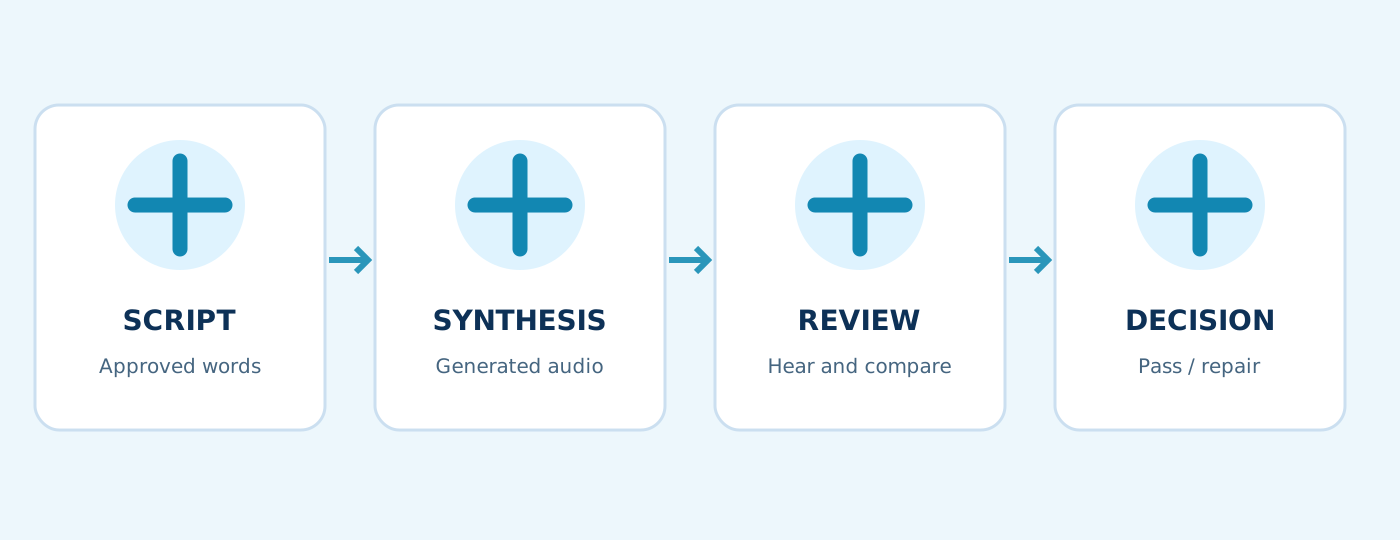
A useful production sequence is script → provider output → language and audio review → correction → evidence-backed decision → publication readback. The purpose is not to slow down creative teams; it is to make their decisions reusable and reduce avoidable rework.
Explore AION's AI Voice learning path, practice with the six-check review exercise and learn how to handle localization. If ElevenLabs is a suitable provider for your workflow, you can Paid referral link: AION may earn a commission if you purchase through this link. review the ElevenLabs offering.
Related AION reading
AION Native educational resource. Illustrations describe review methods, not a verified customer deployment.