
How to Verify an AI Workflow: Outputs, Receipts, and Human Approval
Automation dashboards often make a workflow look successful because a task reached its final step. But a successful step and a successful business outcome are not the same thing. A tool can return a success code while a file was saved to the wrong location, a page is still showing an older version or a scheduled post never appeared on the intended channel.
A verifiable AI workflow connects its declared objective to the material output, the observed state of the destination and a decision made by the appropriate authority. That connection matters particularly when an AI agent can modify files, publish content or interact with external services.
Start with a testable outcome
“Finish the website” is an assignment, not an acceptance criterion. A more testable objective might be: the new page is accessible at its approved URL, displays the correct brand asset on desktop and mobile, and has the required metadata. The team can then ask what evidence proves each condition.
Define the expected output, owner, destination, constraints and release conditions before execution. This prevents a later status summary from redefining what completion means.
Separate action receipts from outcome receipts
An execution receipt proves that an action was attempted or accepted by a tool. It does not always prove that the destination changed. A provider might acknowledge a request while the final page, file or social post remains unchanged.
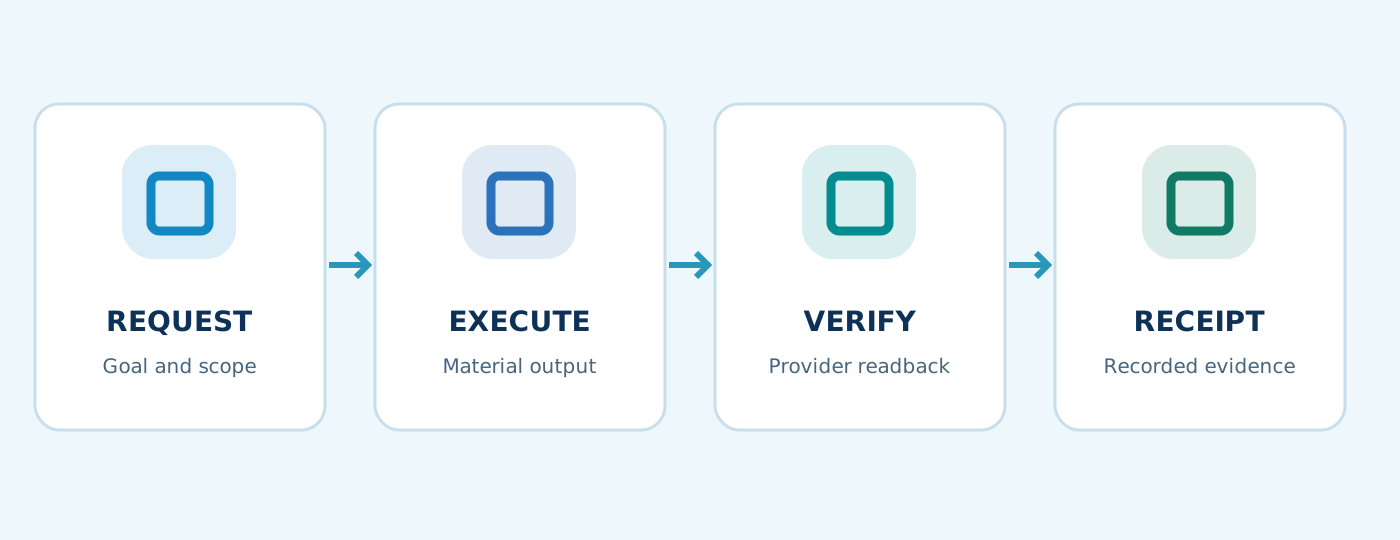
A useful verification sequence contains four distinct signals:
- Request: what operation was authorized and under which input version?
- Execution: what did the tool or worker report?
- Material output: which artifact, destination or state was actually created or changed?
- Readback: what does an independent observation of the destination show after the action?
Not every workflow needs a complex audit trail. High-impact actions, public publishing and financial operations, however, benefit from a reliable separation between these signals.
Verify the destination, not only the producer
For a website, inspect the served HTML and rendered pixels after deployment. For a document, open the file or compare its content checksum. For a provider submission, examine the provider's own visible state or available receipt. Where a result depends on a third-party system, verify it using that system's authorized evidence.
The distinction matters because a staging artifact can be excellent while production is still serving yesterday’s release. A test that validates local files should report staging passed, not production completed.
Preserve authority and version boundaries
An autonomous worker should know which resources it may modify, which decisions require a human and which operations are forbidden. In concurrent systems, ownership, version comparison and lease or fencing mechanisms can help prevent two workers from applying incompatible changes. An expired lease is not a valid authorization merely because a database row still says ACTIVE.
Approval must come from an authorized source. Workers should not mint review results, impersonate an independent assessor or expand a tool's write scope to make a task finish faster.
Make failures visible and repairable
When the final readback does not match the expected outcome, preserve the first broken transition. For example, if an approved website update passes build checks but never reaches the live server, repeating the build may add no value. Investigate the deployment route, the write authority and the destination state instead.
Good recovery records identify the affected output, the pre-change version, the suspected cause, the actual repair, the regression result and any rollback action. They also keep unrelated tasks moving when those tasks do not depend on the failed path.
Design evidence users can understand
Technical receipts support trust, but raw logs often fail as website communication. A prospective customer should be able to see what went in, what happened, what came out and why it was accepted or rejected. Use clear diagrams, appropriately cropped screenshots and captions. Let readers inspect original evidence without pretending a tiny image proves details they cannot read.
For claims that depend on recorded results, cite the actual artifacts. Avoid fabricated production metrics, fictional customer stories and generic “100% autonomous” claims that cannot be demonstrated.
A compact acceptance checklist
Before marking a workflow complete, confirm that the objective has measurable criteria, the worker acted within permission, the right destination was changed, material evidence exists, relevant independent checks were run, the provider state was read back where necessary and any human-only decision was preserved.
The final state should remain pending, blocked or unverified when an essential fact cannot be established. That is not a failure of automation; it is a more useful description of what the organization still needs to do.
See AION's verification approach, autonomous operations, agent model and operating model lesson for connected learning paths.
Review AION’s verification framework, expected receipts and Human approval boundaries before evaluating tools.
Explore verificationAION Native educational resource. Illustrations describe review methods, not a verified customer deployment.