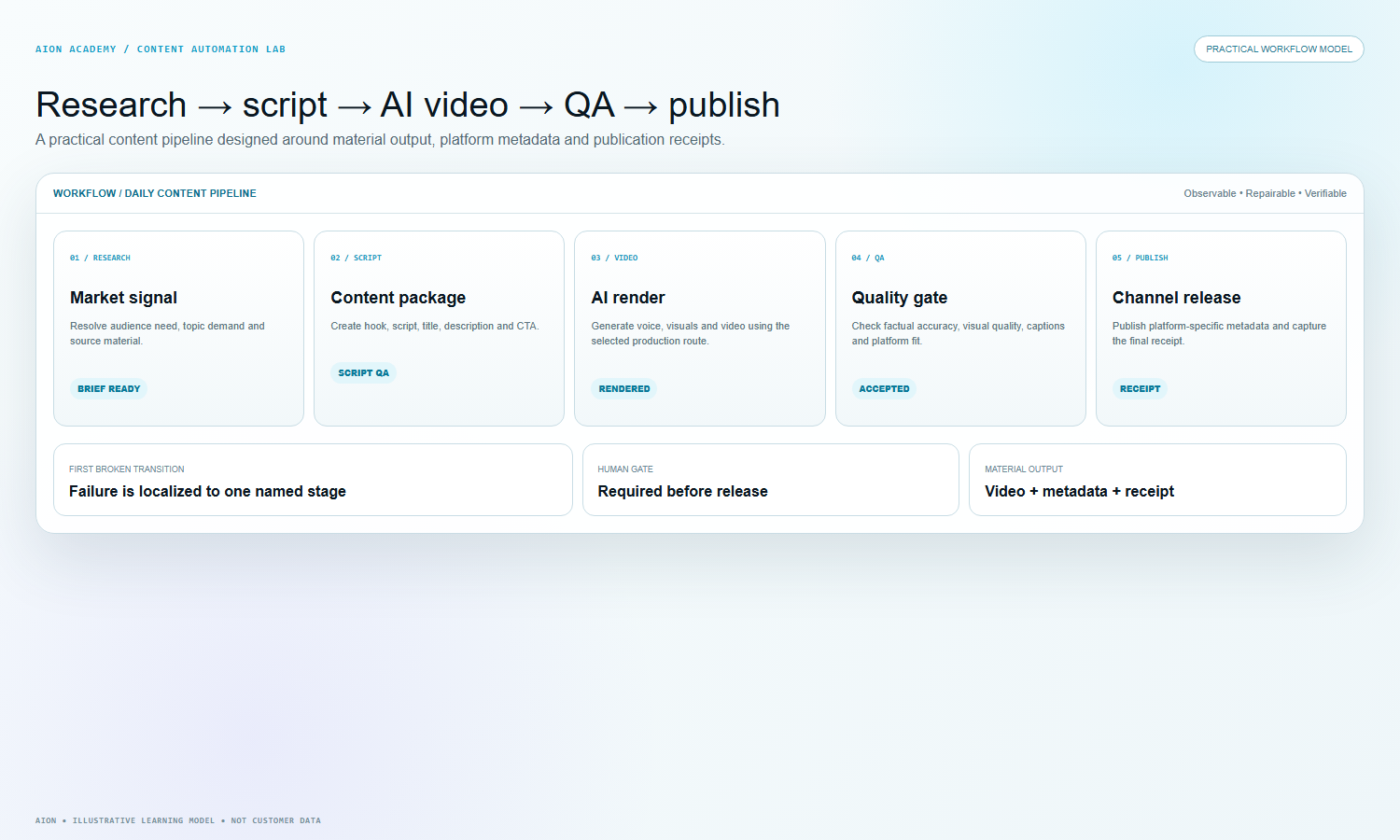
AI-assisted production is not one operation called "generate content". Research, writing, evidence review, rights, SEO, publication and distribution require different acceptance criteria. The process below is designed for marketing operations, editorial teams and workflow builders who need accountable outputs.
Scope note: This is a general implementation framework, not a claim that any specific AION customer deployment has passed these checks.
1. Start with a bounded editorial brief
The brief should state the intended audience, locale, channel, search intent, desired outcome and evidence sources. A generic request to create more content is insufficient: the workflow needs a way to distinguish a useful response from a plausible but off-target draft. Assign one owner to approve the business goal before automation produces assets.
Define what the output must contain and what it must never claim. Set a canonical page target, an approval checkpoint and an explicit status model such as draft, needs review, approved, published or rejected. Keep those states separate: a generated file or successful automation node is not a public publication.
Acceptance checks
- Record audience and language before generation.
- Identify one content owner and an approval criterion.
- Reserve the final URL without declaring it published.
2. Gather sources and retain provenance
Automated research should preserve where factual statements came from. Store links, revision dates and the relevant document or provider receipt; verify that a quote or statistic supports the intended claim. When information is unclear or unsupported, mark the uncertainty instead of blending guesses into an authoritative paragraph.
Separate original analysis from reproduced material, provider terms and commercial claims. A content pipeline can make drafting faster, but it cannot substitute for permission to use a customer's data, a paid asset or an image that belongs to another party.
Acceptance checks
- Record source locations and verification dates.
- Reject unsupported figures and customer success claims.
- Check permissions and data-handling rules.
3. Generate a useful draft, not just metadata
A search-oriented page must answer the reader's question in the body. Include the actual procedure, limits and the evidence needed for implementation; do not mistake a title, short card, or section summary for a complete article. Write in the language appropriate to the intended market. For AION's global English pages, English is the default editorial language until a separately reviewed locale is published.
Use a clear H1, descriptive subheadings and internal links to the next useful step. Metadata should accurately summarize the visible page. Repeatedly injecting a keyword is not a substitute for distinct intent or original examples.
Acceptance checks
- Confirm the article stands alone when opened from a search result.
- Match title and description to the actual body.
- Connect the page to related learning and product routes.
4. Run independent content and accessibility QA
Check factual accuracy, logical order, unsupported promises, broken references and the readability of the final layout. A reviewer should be able to reject a candidate without quietly publishing an earlier version. Keep the revision chain so that a new artifact can be traced to the exact reviewed draft.
Inspect the rendered page on both narrow and wide screens. Confirm headings, keyboard focus, link labels, readable contrast, image alternatives and responsive images. Automated checks help identify defects, but a screenshot alone does not confirm that a link opens the intended article.
Acceptance checks
- Validate one main heading and self-referencing canonical URL.
- Test keyboard and mobile navigation.
- Require a reviewer decision on the exact artifact version.
5. Publish with reversible release controls
Before release, preserve the current served version, compute a content digest and confirm the destination domain. Deploy only the reviewed files. A production publish step should be followed by a separate public HTTPS request: a successful upload merely proves transfer, not reader access.
If public content differs from the reviewed artifact, treat the release as incomplete and restore the known-good preimage when needed. A deployment receipt should identify the source, changes, target, validation result and rollback path. Do not claim a new page is indexed because it appears in the sitemap.
Acceptance checks
- Verify public HTTP and exact content after release.
- Keep rollback material for the previous version.
- Distinguish published, crawlable and indexed statuses.
6. Connect search discovery and distribution
Place the full article in a navigable editorial library and link to it from relevant Academy or product pages. Use distinct canonical URLs, a maintained sitemap and contextually relevant internal anchors. Ensure promotional snippets link to an actual page instead of a heading-only card.
After verifying the site, adapt the approved message for each authorized channel and language. A scheduled social item is not the same as a provider-confirmed post; its status should be backed by a permalink or a reliable provider receipt.
Acceptance checks
- Link from an index and at least one related page.
- Add the new route to the public sitemap.
- Confirm any scheduled distribution through provider readback.
7. Measure qualified outcomes and revisit the brief
Track whether a search visitor reached the relevant content, explored a learning workflow or requested a business conversation. Search Console and analytics can reveal impressions, click-through, device splits and conversion behavior, but these values must come from real connected measurements. Never fabricate ranking improvements from technical QA.
Use the data to refine content clusters and language priorities. When a new locale demonstrates demand, publish a complete localized experience with appropriate canonical and hreflang relationships. Avoid translating an international product site into one language only because the operator works there.
Acceptance checks
- Review observed query intent before adding another article.
- Measure a meaningful downstream action.
- Refresh source dates and content only when material changes occur.
Practical release checklist
- The market, language and reader intent are explicit.
- Sources and permissions are traceable.
- The full article is genuinely useful when opened independently.
- The exact version passed editorial and accessibility review.
- Production HTTP matches reviewed content, with rollback available.
- Its URL is linked from the Insights index and sitemap.
- Distribution claims and search performance are supported by actual provider data.
Related AION reading
Explore how to verify workflow evidence, quality control for synthesized voice, an observable automation walkthrough, the AION verification model and the change-history archive.
Editorial method, not legal advice. Provider terms and project approvals remain specific to the real use case.