AI projects often begin with an appealing demo: a document is summarized, a voice clip is generated, or a request moves between two apps. The demo establishes technical possibility. It does not establish economic value, reliable quality or safe operations. A credible return-on-investment assessment starts with the business decision the workflow must support.
1. Name the outcome before choosing the tools
Write one sentence describing the job to be done, the intended user and a verifiable result. For example: “Turn approved product updates into accessible, reviewed customer guidance that the correct audience can find and act on.” This is stronger than “publish more AI articles,” because it identifies a purpose and an acceptance test.
Decide what happens after the output is produced. A content page might lead someone toward understanding AION, an implementation guide or a workflow conversation. A third-party referral should remain optional unless it directly solves a reader problem.
- Describe who receives the result and how they judge its usefulness.
- Define what counts as accepted, rejected or requiring human review.
- Exclude outputs that were generated but never delivered or were later withdrawn.
2. Establish a fair baseline
Before making comparisons, capture how the work is done today. Include preparation time, active execution, wait time, quality review, rework, exceptions, support and handoffs. A process that takes five minutes to run but three days to approve has a different bottleneck from a slow manual data-entry task.
Use comparable units: accepted cases per week, minutes of human effort per accepted case, error rate per case and total monthly operating cost. Keep the observation window consistent. Record seasonal demand or a change in customer mix so those factors are not misreported as an automation improvement.
- Measure at least one normal period before introducing the workflow.
- Use the same quality standard for manual and automated outcomes.
- Separate high-volume routine cases from rare, complex exceptions.
3. Use a balanced outcome scorecard
A single metric such as “tasks executed” can hide expensive errors. Track a short scorecard that includes business impact, efficiency, reliability and quality. Each measure needs a source, an owner and a clear definition.
| Measure | Question | Evidence |
|---|---|---|
| Accepted outcome rate | How many eligible cases passed the agreed acceptance check? | Acceptance receipts and reviewed case IDs |
| Human minutes per accepted result | Did the team spend less active time, including review and rework? | Time samples by stage |
| Quality and rework | What share needed correction, rollback or escalation? | QA decisions, defects and revisions |
| Cycle time | Did the user receive the outcome sooner? | Trigger-to-delivery timestamps |
| Cost per accepted outcome | Do operating and review costs justify the accepted result? | Provider charges, staff effort and infrastructure cost |
| Qualified conversion | For customer journeys, did useful actions follow the content? | Verified inquiry, customer conversation or completed next step |
4. Calculate the economics without hiding review costs
For a defensible estimate, use net monthly benefit = avoided manual effort value + other validated benefit − incremental operating cost − review and rework cost. Then compare that benefit with implementation and maintenance investment over an explicit period. Avoid presenting a theoretical “hours saved” calculation as realized cash savings when the staff hours were redeployed rather than eliminated.
An illustration: suppose 300 eligible cases arrive in one month and a verified workflow reduces active human effort by six minutes per accepted case. That is 30 hours of gross effort capacity. The net result is lower if some cases fail QA, require extra review or incur provider costs. Treat the example as arithmetic, not as a claim about AION customers.
If a provider is billed per request, account for retries, abandoned outputs and quality tests. A cheap generation price can become expensive when unacceptable outputs are repeated or human reviewers must start over.
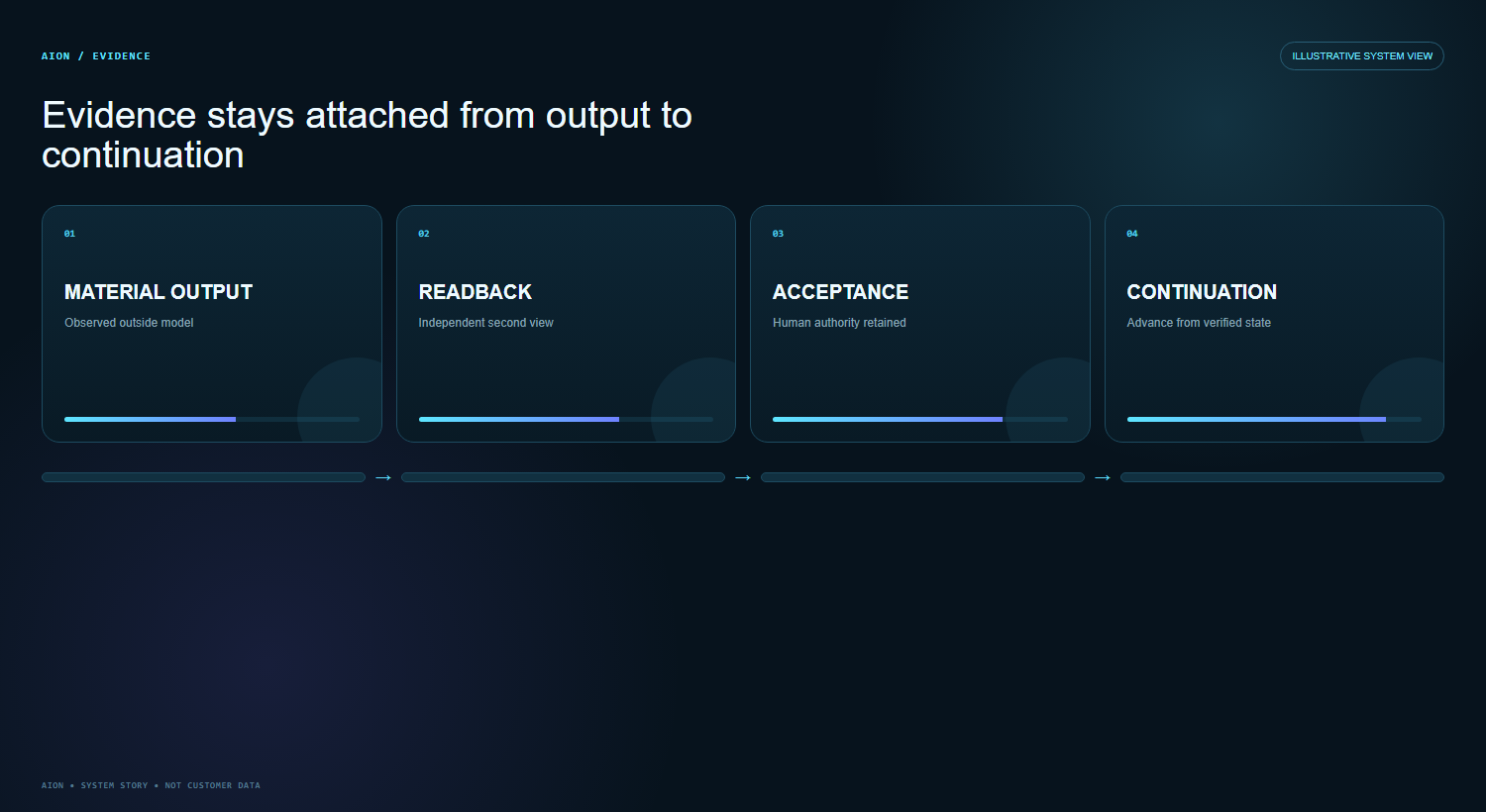
Do not confuse an automation receipt with a business acceptance receipt. Successful execution proves something ran. Acceptance proves the intended outcome was verified.
5. Instrument the workflow for trustworthy decisions
A useful event trail links the trigger, workflow version, run identifier, output reference, QA decision, reviewer if required, delivery destination and final acceptance state. The record should distinguish started, generated, reviewed, accepted, rejected and published. Make retries identifiable so a duplicated event does not inflate success counts.
Collect only the fields needed to measure the process. Do not place customer secrets or unnecessary personal data into analytics events, URLs or public evidence. Apply retention and access rules that match the data and the relevant market. Where a provider reports publication, verify it through a provider readback rather than trusting a scheduler status.
For website content, distinguish a published URL from an indexed page, and distinguish indexed traffic from a qualified business inquiry. Those transitions require different evidence sources; a sitemap entry cannot confirm a conversion.
- Use a stable case identifier and event timestamps.
- Separate internal QA from independent review and real provider delivery.
- Require an explicit acceptance decision before a result enters the numerator.
6. Apply the scorecard to SEO, Content OS and AION leads
For a content program, begin with the reader’s question. Provide a complete, accessible explanation and then offer a relevant next step: a tutorial, a verification method, a product capability or a conversation about implementation. Count those stages separately; pageviews alone do not show whether the right people found value.
AION’s website is a global product and solutions destination. The primary conversion is a meaningful relationship with someone evaluating an AION workflow. An optional integration tool may appear in the tutorial when it is useful to the task, but affiliate clicks are a secondary metric and should not override product fit or trust.
Useful funnel measures include organic landing-page engagement, progress to a related guide, Contact navigation, customer-initiated inquiries and finally verified qualified conversations. If there is no connected lead database, report the earlier steps honestly. An email draft prepared on a device is not a recorded lead.
7. Run a controlled comparison, not a launch celebration
Choose one workflow family, define an acceptance rubric and select a trial period. Use a sample that includes normal cases and realistic failures. Compare performance against the baseline. Track failed outcomes and time spent on fixes as first-class data, not as exceptions quietly removed from the chart.
If results are inconsistent, identify the broken transition: poor inputs, provider outages, wrong locale, missing authority, late approvals or unclear success criteria. Improve the smallest failing stage, retest it and continue only after the relevant evidence is available.
Changes to provider accounts, paid tools or security-sensitive data routes should be separately authorized. A good cost-control decision is often to improve a reliable workflow before increasing model or infrastructure spending.
8. Decide when to scale, repair or stop
Scale when accepted results are consistent, operational ownership is clear, failure recovery works and the economics remain reasonable under real usage. Repair when the value proposition is sound but a specific quality or integration step breaks. Stop or redesign when a workflow repeatedly generates outputs that users do not accept, even if technical uptime is high.
Revisit the scorecard after deployment. A previously successful process can degrade when source material, service pricing, policies or customer needs change. Version your assumptions and preserve the evidence that justified the original decision.
Common questions
Should we track tokens or model requests?
They are useful cost and capacity diagnostics. They are not the primary business outcome. Tie their cost to accepted work and the quality of the result.
How do we value human review?
Measure review time and the errors the review prevents. Treat mandatory review as part of the service, not as wasted overhead, and compare processes using the same acceptance standard.
What if the workflow has no revenue figure yet?
Start with accepted quality, cycle time, reliability and effort. Label modeled value as an estimate until actual financial or conversion evidence exists.
Next step: design a measurable AION workflow
Start with a process that matters to your team. Map the desired outcome, current handoffs, quality gates and measurements. Explore an observable automation walkthrough, study workflow verification evidence or review the AION platform approach.
Discuss your workflow with AIONTalk about your use case and the evidence you need; no software purchase is required to begin a conversation.